How Much Do Custom Garage Cabinets Cost?
Custom garage cabinets usually run from about 3,000 dollars to 15,000 dollars for a full wall, and small single runs start near 1,000 dollars. The final bill depends on linear feet, material, finish, hardware and installation.
On this page (8 sections)
- How much do custom garage cabinets cost per linear foot?
- What does a custom garage cabinet project actually include?
- Which materials drive the price up or down?
- How much does installation add to the bill?
- When do stock steel cabinets make more sense than custom?
- Can you save money by mixing custom and stock cabinets?
- How do you get a useful custom cabinet quote?
- How much should you budget for custom garage cabinets overall?
Custom garage cabinets usually cost about 3,000 dollars to 15,000 dollars for a full wall, and a single small run starts near 1,000 dollars. If you're pricing out how much custom garage cabinets cost for your own space, the number moves with linear feet, material, finish and whether you install them yourself.
There's no single sticker. Custom work is priced per project, so two garages of the same size can land far apart.
This guide breaks down what you're actually paying for and when a stock cabinet is the smarter buy.
How much do custom garage cabinets cost per linear foot?
Plan on roughly 300 dollars to 800 dollars per linear foot installed for a typical mix of base cabinets and uppers. The low end covers painted MDF or laminate with basic doors.
The high end covers hardwood, soft-close hardware and a countertop.
Linear feet is the easiest way to compare quotes. Measure the wall you want to cover and multiply by that range to get a ballpark before you call anyone.
A 12-foot wall, for example, lands somewhere between 3,600 dollars and 9,600 dollars.
Prices climb quickly when the design gets busy. Deep drawers, pull-out trays, integrated lighting and custom trim all add cost without adding much storage.
The per-foot figure also assumes a straight, open wall. A run that has to wrap a corner, step around a water heater or notch under a window takes more cutting and fitting, so the same 12 feet can cost more than a plain stretch.
Ask whether the quote prices a continuous run or breaks it into separate boxes.
What does a custom garage cabinet project actually include?
A quote should cover design, materials, fabrication and installation, and you want each line item spelled out. A number that lumps everything together is hard to compare against another bid.
Most projects include measuring the space, drafting a layout, cutting and finishing the parts, delivering them, and fitting the doors and drawers. Some shops charge separately for design work.
Ask whether the price includes the counter, handles, hinges and any wall repair. Small extras add up fast when they're billed after the fact.
A few more line items to check are whether the shop hauls away old shelving and whether touch-up paint comes with the job. Those small services are easy to leave off a bid and easy to charge for later.
Which materials drive the price up or down?
Material is usually the single biggest swing in the budget. Painted MDF and laminate are the affordable choices.
Plywood, hardwood and custom stains cost more.
MDF paints smooth and holds up well in a dry garage. Plywood handles moisture and weight better, which matters if you store heavy tools.
Hardwood gives you the best look and the highest bill.
If you want the look of wood without the wood price, painted cabinets with a simple shaker door do most of the visual work. Save the hardwood for a single feature wall.
Finishing is a separate cost inside the material line. A sprayed, factory-style finish costs more than a brushed-on coat, and a custom stain match adds labor on top.
Hardware is its own small line too. Soft-close hinges and drawer slides are worth the money in a garage where doors get slammed, but they push a painted set toward the top of its range.
Steel is the other path. It's built for garages and shrugs off moisture and dents in a way wood can't always match.
Our comparison of metal cabinet vs wood cabinets walks through where each one wins.
How much does installation add to the bill?
Professional installation typically adds 20% to 40% on top of the cabinet cost. The labor covers leveling, fastening to studs, fitting doors and adjusting drawers.
Installing them yourself saves that labor, but only if you're comfortable with a level, a stud finder and a drill. A wobbly run of cabinets is worse than none.
Wall condition matters too. A garage with uneven concrete or sloped framing needs more prep, and that shows up in the labor line.
Get the installer to look at the walls before quoting. A cabinet that leans away from the wall will fight its doors for years, so leveling and shimming are not optional steps.
When do stock steel cabinets make more sense than custom?
Stock steel cabinets win whenever your space is standard and your priority is storage per dollar. They arrive as complete units, so the cost per shelf is far lower than custom millwork.
Steel also suits a working garage. It resists moisture, wipes clean and takes a lock.
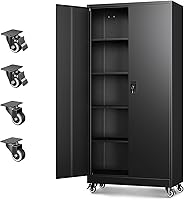
A tall locking cabinet keeps tools and chemicals out of reach, and rolling units let you move storage to where the project is.
Here are three steel options we checked that cover different garage jobs.
One trade-off is real: steel looks utilitarian next to stained wood. If the garage doubles as a showroom or a workshop you want to enjoy, custom wood still has the edge on looks.
For a plain, hard-working space, steel is hard to beat. Browse more options in our guide to garage cabinets.
How do the three steel picks differ in practice?
The Yizosh cabinet is the tall, narrow one. It measures 17.7 inches deep by 35.4 inches wide by 71.8 inches high and stands on legs, so it tucks into a corner and still gives you five shelves you can move to suit the load.
Its two doors open a full 180 degrees, which helps when you're pulling a long tool case off a shelf. The wall mount anchor in the box matters here, since a 72 inch cabinet full of tools should be tied to the wall.
The SISESOL rolling cabinet is the mobile one. At 43.3 inches wide and 20 inches deep it holds more than the Yizosh, and the four shelves, two pegboards and four hooks split the space between flat storage and hanging tools.
Its casters swivel and lock, so you can roll it to the car and pin it in place. The cabinet ships in two boxes that may arrive at different times, which is worth knowing before you clear a weekend for the build.
The second SISESOL unit is the heavy-duty fixed option. It's 36 inches wide, 18 inches deep and 72 inches tall, with a 900 lb total rating and 180 lb on each of its five shelves.
The door has magnets to keep it shut and a three-point locking system. If you store dense gear like power tools and paint, this is the one built for the weight.
Can you save money by mixing custom and stock cabinets?
Yes, and it's the most practical way to get a custom look on a smaller budget. Put custom cabinets on the wall you see first and steel or stock units on the working side.
This split keeps the cost down while still giving you a fitted look where it counts. Match the cabinet depth and counter height so the two runs line up.
A 20 inch deep steel unit next to an 18 inch deep custom run will look like a mistake, so settle the depth before you order either one.
Another saving is to skip the counter on secondary walls. Open shelving above a steel base does the same job for less.
You can also use a steel cabinet as the base and buy only the custom doors for the run beside it, which trims the millwork bill while keeping the front view consistent.
If assembly time is the concern, some stock cabinets arrive ready to hang. Our post on fully assembled garage storage cabinets covers what's available.
How do you get a useful custom cabinet quote?
Give every shop the same measurements and the same list of needs so the bids are comparable. A quote built on a vague description is hard to trust.
Measure the wall length, the ceiling height, the depth you want and the location of outlets and doors. Note what you plan to store, since that sets shelf spacing and drawer count.
Ask each shop what's included and what costs extra. Get the finish, hardware and install terms in writing.
Three quotes on the same spec is the fastest way to see the real range.
It helps to bring photos of the wall along with the numbers. A slope in the floor or a beam at the ceiling changes the design, and a shop that sees it up front won't surprise you with a change order later.
Ask when the quote expires too, since material prices move.
How much should you budget for custom garage cabinets overall?
Budget 3,000 dollars to 15,000 dollars for a full custom wall, or 1,000 dollars and up for a small run, and keep a cushion for installation and extras. The figure you land on should match how much you'll actually use the space.
If storage is the goal and the look is secondary, steel cabinets deliver more shelves per dollar. If the garage is a space you want to enjoy every day, custom wood is worth the extra.
Our tips on how to keep metal from rusting help steel units last if you go that route.
Either way, measure first and get written quotes on the same spec. That's how you find out what custom garage cabinets cost for your garage rather than a generic average.
Frequently asked questions
Is it cheaper to build custom garage cabinets or buy stock ones?
Stock steel cabinets cost far less. A full custom wall often runs several times the price of a comparable set of ready-made steel units.
Custom makes sense when the garage has odd angles, unusual depth needs or a look you can't find off the shelf.
What is the biggest cost driver in a custom garage cabinet project?
Material and installation usually drive the bill. Hardwood and custom paint cost more than painted MDF or laminate.
Hiring a pro to fit cabinets around doors, outlets and sloped ceilings adds labor that a straightforward stock install avoids.
Do custom garage cabinets add resale value to a home?
They can help a garage show better to buyers, but the return is rarely the full cost. Think of custom cabinets as an upgrade you'll enjoy daily rather than an investment.
A clean, organized garage matters more to most buyers than the cabinet brand.
How long does a custom garage cabinet job take?
Plan on a few weeks from measure to install. Design and quote time adds a week or more, fabrication often takes 2 to 4 weeks, and the install itself is usually 1 to 2 days.
Weather and material lead times can stretch the schedule.
Can I mix custom cabinets with steel cabinets in one garage?
Yes, and many people do. Put custom wood cabinets on the visible wall and steel units where you need lockable, low-maintenance storage.
Keep depths and counter heights aligned so the two styles look intentional rather than accidental.