Melamine Garage Cabinets: Pros and Cons
The melamine garage cabinet pros and cons come down to cost against moisture risk. Melamine gives you a smooth, wipe-clean surface at a low price, but its particleboard core swells when water reaches an exposed edge. Pick melamine for a dry, heated garage; pick steel if your garage sees damp, temperature swings or heavy tools.
On this page (7 sections)
- What are melamine garage cabinets made of?
- What are the main pros of melamine garage cabinets?
- What are the main cons of melamine garage cabinets?
- How does melamine handle moisture in a real garage?
- When should you choose steel cabinets instead?
- How do you protect melamine cabinets in a garage?
- Melamine garage cabinets pros and cons: the verdict
The melamine garage cabinets pros and cons come down to cost against moisture risk. Melamine gives you a smooth, wipe-clean surface at a low price, but its particleboard core swells when water reaches an exposed edge.
Pick melamine for a dry, heated garage, and pick steel if your garage sees damp, temperature swings or heavy tools.
That one split decides most of the debate. A garage is a harsher home for cabinetry than a kitchen, because it swings from summer heat to winter cold and often takes in rain off a car.
This guide walks through what melamine does well, where it fails, and how to judge your own garage before you buy.
What are melamine garage cabinets made of?
Melamine cabinets are a manufactured board with a resin coating on the outside. The core is usually particleboard, which is wood chips pressed and glued into a sheet.
The melamine is a thin, hard laminate fused to the faces.
The coating is the part you touch. It comes in solid colors and woodgrain prints, and it is what gives melamine its smooth, easy-clean finish.
The particleboard underneath carries the weight and holds the screws.
Those two layers behave very differently around water. The coating shrugs off a splash, while the raw core soaks it up.
That is why the same cabinet can look fine on the face and still fall apart at a cut edge or a screw hole.
Garage cabinets built from melamine are usually flat-pack kits or custom-built units. The panels are cut, edged and drilled, then assembled on site or in a shop.
Quality varies widely with how well the edges are sealed. A cheap kit with a thin edge band leaves more raw core exposed than a shop-built unit that glues and trims its own edges.
How melamine differs from plywood and MDF
Melamine describes a surface finish, not a board type. You can buy melamine-faced particleboard, and you can also find melamine-faced MDF or plywood.
Plywood is layered veneer, so it resists water and screws better than particleboard. MDF is a dense fibreboard with a fine, uniform texture.
For a garage, the practical question is the core more than the name on the front. Melamine over plywood costs more but handles damp better than melamine over particleboard.
Melamine over MDF takes paint and router work neatly but still swells at raw edges. Before you buy, ask what sits under the coating, because the answer decides how the cabinet behaves in a wet winter.
If you are weighing cabinet materials more broadly, our metal cabinet vs wood comparison covers the steel side of the same decision. Melamine sits in the wood-based camp, with the same core weakness and the same finishing strengths.
What are the main pros of melamine garage cabinets?
The pros are real, and they explain why melamine stays popular for garage storage. It costs less than steel or plywood, it cleans up easily, and it gives you color choices a plain steel box cannot match.
For a dry garage with light-to-medium storage, it does the job.
Here is what melamine brings to a garage wall.
| Pro | What it means in a garage |
|---|---|
| Low material cost | More cabinet and shelf for the same budget than steel or plywood |
| Wipe-clean surface | Oil, dust and fingerprints come off with a damp cloth |
| Scratch and stain resistance | The hard coating holds up to everyday scuffs better than bare wood |
| Color and finish choice | Solid colors and woodgrains to match a wall or floor |
| Easy to cut and fit | Standard panels and fittings suit custom shapes and odd corners |
| Light panels | Easier to carry and hang than a steel cabinet of the same size |
Where melamine wins in a garage
Melamine is at its best on upper cabinets and closed storage that stays dry. A row of wall cabinets over a workbench hides clutter and keeps dust off, and the smooth face wipes down in seconds.
It also takes a shelf pin or a hinge without the hollow ring of thin steel.
If your garage is heated, insulated and used as a workshop or a home gym, melamine is a sensible, budget-friendly choice. You get a finished look without paying steel or custom-wood prices.
Our garage cabinets buying guide covers how to plan a full wall of storage around that kind of room.
Custom melamine layouts are also cheaper than custom steel. If you want a built-in look that fits an awkward corner, melamine panels are easy to cut and edge on site.
See what a fitted run costs in our guide to how much custom garage cabinets cost.
What are the main cons of melamine garage cabinets?
The cons all trace back to the particleboard core and the raw edges. Melamine resists a spill on its face, but it does not resist water that reaches the core.
Once that happens, the board swells and the damage is permanent.
Weight and moisture are the two weak spots. A particleboard shelf across a long span sags under heavy tools.
A cabinet in a damp corner or under a roof leak swells at the base and the back panel first. The heavier the load and the wider the span, the sooner the shelf bows.
- Edge swelling: A cut edge or a chip lets moisture into the core. The board bulges and will not flatten again.
- Screw pull-out: Particleboard holds screws less firmly than plywood or steel, so a loaded shelf can work its fixings loose over time.
- Sag under load: Long shelves need center support, or they bow under tool weight.
- Water at floor level: A wet floor after rain or snow melt can reach the base panel and start the swelling there.
- Heat and humidity swings: An unheated garage moves through damp and dry cycles that stress every raw edge.
Where melamine fails in a garage
Melamine is a poor fit for an unheated, damp or leaky garage, and for storage of heavy tools on long shelves. A garage that takes in a wet car, has a dripping roof or sits at the bottom of a slope will find every weak edge on the cabinet.
It also struggles where you hang heavy items. A cabinet door loaded with tools pulls on hinges fixed into particleboard.
Over time those fixings loosen, and the door starts to sag. The same happens when a shelf is screwed into a thin panel instead of a reinforced rail.
None of this makes melamine a bad product. It makes it the wrong product for a wet, cold or heavily loaded garage.
The next section covers how to judge which garage you actually have.
How does melamine handle moisture in a real garage?
Melamine handles a wiped-up splash well and standing water badly. The coating keeps a spill on the surface long enough to wipe it away.
Water that sits against a raw edge, a screw hole or the floor line gets into the core and starts the swelling.
The damage is not always visible at first. A swollen base panel can look fine from the front while the bottom edge has already crumbled.
The back panel, which is often thinner and less protected, is usually the first part to fail. That thin back sheet is also the part most kits leave with an unsealed cut edge.
Winter makes this worse. Snow melt off a car pools on the floor and creeps under the cabinet.
A cold garage also holds damp air against the panels longer, so the wood stays wet instead of drying out. Summer heat on top of that dries the outer face fast while the core stays damp, which stresses the coating and can start a split at the edge.
If your garage stays dry, this section is less of a worry. If it does not, melamine needs help: seal the cut edges, lift the cabinet off the floor on a plinth and keep the base away from puddles.
Even then, a steel cabinet removes the risk instead of managing it.
When should you choose steel cabinets instead?
Choose steel cabinets when your garage is damp, unheated or used for heavy tools. A powder-coated steel cabinet has no wood core to swell.
It holds its shape through temperature swings, wipes clean and locks tools away behind a keyed door.
Steel is also the better pick for anything that must stay secure. A locking steel cabinet with a keyed door keeps power tools and chemicals out of reach.
Particleboard doors and frames are easier to force than a steel shell.
The trade-off is cost and weight. Steel cabinets usually cost more than melamine for the same footprint, and a tall steel unit is heavy to move into place.
You also need to watch for rust on scratches and keep metal dry. A flat-packed steel cabinet arrives as panels and takes an evening to assemble, so plan for that time before delivery day.
Our guide to how to keep a metal garage cabinet from rusting covers the upkeep side, from touch-up paint to keeping the base off a wet floor. For most damp or hard-working garages, steel is the buy that lasts.
Steel cabinet picks for a garage
If steel is the right call for your space, these three units show the range. They are the same brand family, so the differences are size and finish rather than construction.
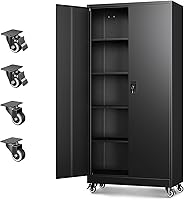
The tallest of the three at 72 in, with 17.7 in of depth and a keyed lock with two keys. Its five shelves adjust to fit tool cases and bins, and the frame is cold-rolled steel with a powder coat.
This is the pick when you need secure, heavy-duty storage in one tall unit. The wall anchor in the box lets you fix the top to a stud so a loaded cabinet cannot tip.
At 31.5 in wide and 15.7 in deep, this one fits a tighter stretch of wall while keeping five shelves and a lock. The narrower footprint means less floor taken up beside a car.
Pick it when width is the constraint and you still want full-height steel storage. Its shelves carry the same 180 lb rating as the wider unit, so the smaller size does not mean lighter-duty storage.
Same footprint as the black 72 in model at 17.7 in deep and 35.4 in wide, but finished in white. A light finish helps a small, dim garage read as bigger.
The white hardware and keyed lock match the body. It ships flat with the shelves, keys and wall anchor in the box, and both doors open to a full 180 degrees so you can reach the back of the shelves.
All three have a 2-year quality assurance from Yizosh, and all three ship flat with the shelves and wall anchor in the box. Pick the 72 in black for locking up tools, the 71 in black for a tighter wall, or the 72 in white for a brighter room.
How do you protect melamine cabinets in a garage?
You protect melamine by sealing every raw edge and keeping water off the board. The coating already handles the faces.
The work is in the cuts, the screw holes and the base.
- Seal cut edges with a matching edge band or a waterproof sealant before assembly.
- Run a thin bead of sealant around screw holes and hinge fixings.
- Lift the cabinet on a plinth or adjustable feet so the base stays off a wet floor.
- Wipe up spills and snow melt quickly rather than letting water pool.
- Add a center support under long shelves that carry heavy tools.
- Touch up chips in the coating before moisture gets into the core.
Sealing and repair jobs that matter most
The base panel and the back panel need the most attention. They sit closest to the floor and are often the thinnest parts of the cabinet.
Seal their lower edges and keep them clear of standing water. If you fit a plinth, seal the joint between the cabinet base and the plinth as well, so splash cannot wick up into the core.
For a chip or a scratch, a matching touch-up marker or a small dab of sealant closes the break before water gets in. Do not wait for the swelling to show, because by then the fix is a replacement panel.
Check the base and back of each cabinet once a season, ideally after the first wet weather of the year.
If the garage is heated and dry, sealing is good practice rather than a rescue job. In a damp garage, it is the difference between a cabinet that lasts a few years and one that lasts one wet winter.
Melamine garage cabinets pros and cons: the verdict
The melamine garage cabinets pros and cons end in a simple split. Pick melamine for a dry, heated garage and light-to-medium storage on a budget.
Its wipe-clean face, color choices and low cost make it a practical, good-looking wall of storage in a room that stays dry.
Pick steel instead if your garage is damp, unheated, leaky or used for heavy and valuable tools. A powder-coated steel cabinet has no wood core to swell and gives you a keyed lock.
For most garages that see weather or hold power tools, steel is the buy that lasts.
If your garage sits somewhere between the two, judge it by the base and the weather. A dry, insulated garage with no water at the floor leans melamine.
A garage that takes in a wet car or swings cold leans steel. Either way, seal the weak points and keep the base off the floor.
Frequently asked questions
What is the difference between melamine and MDF cabinets?
Both are manufactured boards, but they behave differently. Melamine is a resin coating over a particleboard core, so the surface is what you see and the core is what carries the load.
MDF is a denser fibreboard, and it usually arrives painted or veneered rather than finished in melamine.
Are steel cabinets better than melamine in a humid garage?
For a humid or unheated garage, steel is the safer buy. A powder-coated steel cabinet does not have a wood core to swell.
Steel can still rust if the coating is scratched and moisture sits on bare metal, so wipe up spills and touch up chips.
How much weight can melamine shelves hold?
That depends on the shelf thickness, the span between supports and how the cabinet is built. A thin shelf across a wide span sags under heavy tools.
Check the maker's stated shelf load, add a center support on long spans and keep the heaviest items on the bottom.